Showing posts with label Infotainment. Show all posts

Wednesday, March 11, 2015

Long time, no see: Catching up with the QNX CAR Platform

By Megan Alink, Director of Marketing Communications for Automotive

It’s a fact — a person simply can’t be in two places at one time. I can’t, you can’t, and the demo team at QNX can’t (especially when they’re brainstorming exciting showcase projects for 2016… but that’s another blog. Note to self.) So what’s a QNX-loving, software-admiring, car aficionado to do when he or she has lost touch and wants to see the latest on the QNX CAR Platform for Infotainment? Video, my friends.

One of the latest additions to our QNX Cam YouTube channel is an update to a video made just over two and a half years ago, in which my colleague, Sheridan Ethier, took viewers on a feature-by-feature walkthrough of the QNX CAR Platform. Now, Sheridan’s back for another tour, so sit back and enjoy a good, old-fashioned catch-up with what’s been going on with our flagship automotive product (with time references, just in case you’re in a bit of a hurry).

Sheridan Ethier hits the road in the QNX reference vehicle based on a modified Jeep Wrangler, running the latest QNX CAR Platform for Infotainment.

We kick things off with a look at one of the most popular elements of an infotainment system — multimedia. Starting around the 01:30 mark, Sheridan shows how the QNX CAR Platform supports a variety of music formats and media sources, from the system’s own multimedia player to a brought-in device. And when your passenger is agitating to switch from the CCR playlist on your MP3 device to Meghan Trainor on her USB music collection, the platform’s fast detection and sync time means you’ll barely miss a head-bob.

The QNX CAR Platform’s native multimedia player — the “juke box” — is just one of many options for enjoying your music.

About five minutes in, we take a look at how the QNX CAR Platform implements voice recognition. Whether you’re seeking out a hot latté, navigating to the nearest airport, or calling a co-worker to say you’ll be a few minutes late, the QNX CAR Platform lets you do what you want to do while doing what you need to do — keeping your hands on the wheel and your eyes on the road. Don’t miss a look at concurrency (previously discussed here by Paul Leroux) during this segment, when Sheridan runs the results of his voice commands (multimedia, navigation, and a hands-free call) smoothly at the same time.

Using voice recognition, users can navigate to a destination by address or point of interest description (such as an airport).

At eight minutes, Sheridan tells us about one of the best examples of the flexibility of the QNX CAR Platform — its support for application environments, including native C/C++, Qt, HTML5, and APK for running Android applications. The platform’s audio management capability makes a cameo appearance when Sheridan switches between the native multimedia player and the Pandora HTML5 app.

Pandora is just one of the HTML5 applications supported by the QNX CAR Platform.

As Sheridan tells us (at approximately 12:00), the ability to project smartphone screens and applications into the vehicle is an important trend in automotive. With technologies like MirrorLink, users can access nearly all of the applications available on their smartphone right from the head unit.

Projection technologies like MirrorLink allow automakers to select which applications will be delivered to the vehicle’s head unit from the user’s connected smartphone. 

Finally, we take a look at two interesting features that differentiate the QNX CAR Platform — last mode persistence (e.g. when the song you were listening to when you turned the car off starts up at the same point when you turn the car back on) and fastboot (which, in the case of QNX CAR, can bring your backup camera to life in 0.8 seconds, far less than the NHTSA-mandated 2 seconds). These features work hand-in-hand to ensure a safer, more enjoyable, more responsive driving experience.

Fastboot in 0.8 seconds means that when you’re ready to reverse, your car is ready to show you the way.

Interested in learning more about the QNX CAR Platform for Infotainment? Check out Paul Leroux’s blog on the architecture of this sophisticated piece of software. To see QNX CAR in action, read Tina Jeffrey’s blog, in which she talks about how the platform was implemented in the reimagined QNX reference vehicle for CES 2015.

Check out the video here:


Wednesday, January 7, 2015

Now with ADAS: The revamped QNX reference vehicle

Tina Jeffrey
Since 2012, our Jeep has showcased what QNX technology can do out of the box. We decided it was time to up the ante...

I walked into the QNX garage a few weeks ago and did a double take. The QNX reference vehicle, a modified Jeep Wrangler, had undergone a major overhaul both inside and out — and just in time for 2015 CES.

Before I get into the how and why of the Jeep’s metamorphosis, here’s a glimpse of its newly refreshed exterior. Orange is the new gray!


The Jeep debuted in June 2012 at Telematics Detroit. Its purpose: to show how customers can use off-the-shelf QNX products, like the QNX CAR Platform for Infotainment and QNX OS, to build a wide range of custom infotainment systems and instrument clusters, using a single code base.

From day one, the Jeep has been a real workhorse, making appearances at numerous events to showcase the latest HMI, navigation, speech recognition, multimedia, and handsfree acoustics technologies, not to mention embedded apps for parking, internet radio streaming, weather, and smartphone connectivity. The Jeep has performed dependably time and time again, and now, in an era where automotive safety is top of mind, we’ve decided to up the ante and add leading-edge ADAS technology built on the QNX OS.

After all, what sets the QNX OS apart is its proven track record in safety-certified systems across market segments — industrial, medical, and automotive. In fact, the QNX OS for Automotive Safety is certified to the highest level of automotive functional safety: ISO 26262, ASIL D. Using a pre-certified OS component is key to the overall integrity of an automotive system and makes system certification much easier.

The ultimate (virtual) driving experience
How better to showcase ADAS in the Jeep, than by a virtual drive? At CES, a 12-foot video screen in front of the Jeep plays a pre-recorded driving scene, while the onboard ADAS system analyzes the scene to detect lane markers, speed signs, and preceding vehicles, and to warn of unintentional lane departures, excessive speed, and imminent crashes with vehicles on the road ahead. Onboard computer vision algorithms from Itseez process the image frames in real time to perform these functions simultaneously.

Here’s a scene from the virtual drive, in which the ADAS system is tracking lane markings and has detected a speed-limit sign:


If the vehicle begins to drift outside a lane, the steering wheel provides haptic feedback and the cluster displays a warning:


The ADAS system includes EB Assist eHorizon, which uses map data with curve-speed information to provide warnings and recommendations, such as reducing your speed to navigate an upcoming curve:


The Jeep also has a LiDAR system from Phantom Intelligence (formerly Aerostar) to detect obstacles on the road ahead. The cluster displays warnings from this system, as well as warnings from the vision-based collision-detection feature. For example:


POSTSCRIPT:
Here’s a short video of the virtual drive, taken at CES by Brandon Lewis of Embedded Computing Design, in which you can see curve-speed warnings and lane-departure warnings:


Fast-boot camera
Rounding out the ADAS features is a rear-view camera demo that can cold boot in 0.8 seconds on a Texas Instruments Jacinto 6 processor. As you may recall, NHTSA has mandated that, by May 2018, most new vehicles must have rear-view technology that can display a 10-by-20 foot area directly behind the vehicle; moreover, the display must appear no more than 2 seconds after the driver throws the vehicle into reverse. Backup camera and other fastboot requirements such as time-to-last-mode audio, time-to-HMI visible, and time-to-fully-responsive HMI are critically important to automakers. Be sure to check out the demo — but don’t blink or you’ll miss it!

Full-featured infotainment
The head unit includes a full-featured infotainment system based on the QNX CAR Platform for Infotainment and provides information such as weather, current song, and turn-by-turn directions to the instrument cluster, where they’re easier for the driver to see.


Infotainment features include:

Qt-based HMI — Can integrate other HMI technologies, including EB Guide and Crank Storyboard.

Natural language processing (NLP) — Uses Nuance’s Vocon Hybrid solution in concert with the QNX NLP technology for natural interaction with infotainment functions. For instance, if you ask “Will I need a jacket later today?”, the Weather Network app will launch and provide the forecast.

EB street director — Provides embedded navigation with a 3D map engine; the map is synched up with the virtual drive during the demo.

QNX CAR Platform multimedia engine — An automotive-hardened solution that can handle:
  • audio management for seamless transitions between all audio sources
  • media detection and browsing of connected devices
  • background synching of music for instant media playback — without the need for the synch to be completed

Support for all smartphone connectivity options — DLNA, MTP, MirrorLink, Bluetooth, USB, Wi-Fi, etc.

On-board application framework — Supports Qt, HTML5, APK (for Android apps), and native OpenGL ES apps. Apps include iHeart, Parkopedia, Pandora, Slacker, and Weather Network, as well as a Settings app for phone pairing, over-the-air software updates, and Wi-Fi hotspot setup.

So if you’re in the North Hall at CES this week, be sure to take a virtual ride in the QNX reference vehicle in Booth 2231. Beneath the fresh paint job, it’s the same workhorse it has always been, but now with new ADAS tech automakers are thirsting for.

Monday, January 5, 2015

QNX and Qualcomm Technologies give show goers another stunner at 2015 CES

Guest post By Nilesh Parekh, Director of Product Management at Qualcomm Technologies

Year after year, CES attendees are repeatedly amazed by the advances in automobile infotainment. Not so long ago, it was about having a great stereo in the car and maybe a tiny screen in the center stack with a primitive navigation system. Then came Bluetooth connectivity… multiple multimedia screens… front and rear displays… gaming… 3G and 4G connectivity… Wi-Fi hotspots…

This year, QNX Software Systems and Qualcomm Technologies are bringing you something really special — a “mashup,” you could say, of a Maserati Quattroporte GTS, the QNX OS, the QNX CAR Platform, and the Snapdragon™ Automotive Solutions (SAS) platform, all working together in a show-stopping technology concept car.


The QNX concept team worked closely with Qualcomm Technologies to create an immersive in-vehicle experience using advanced technologies for infotainment, digital instrument clusters, and driver assistance systems. These systems feature high-resolution UIs with multi-touch support, 3D graphics for navigation, and LiDAR-based obstacle detection. And note the side mirrors have been swapped for smart displays that eliminate typical vehicle blind spots and present relevant color-coded overlay information to promote safer driving.

Inner beauty
Admittedly, the car is a thing of beauty. But being in the tech field, I find the real beauty inside the car — deep inside. There, working hand-in-hand with the field-proven QNX OS, is the Snapdragon Automotive Solutions (SAS) platform. The SAS platform manages all infotainment features; it also processes vital vehicle safety information, collected via a myriad of camera, ultrasonic, and LIDAR sensors, and delivers all relevant information to the driver in real time — that’s a lot of computing and processing power.

What’s so special about the SAS platform? First, let me define what it is (put on your tech hats): a highly integrated, thermal-efficient automotive-grade platform that incorporates an optimized combination of CPU, GPU, 4G LTE modem, GPS/GNSS, Bluetooth, and Wi-Fi. What’s special is that it is engineered to not only enhance the driver and passenger experiences with the infotainment features we know today, but it future-proofs the vehicle for next-generation features — some of which haven’t even been dreamt of yet. More important, it allows automakers and tier ones to accelerate development schedules and to focus on creating feature-rich, reliable infotainment and safety systems built with solutions such as the QNX CAR Platform.

Let’s take a closer look at the three areas of this special technology concept car where I think the presence of SAS makes the biggest impact: the instrument cluster, the infotainment system, and the driver assistance system. And keep in mind that this vehicle is more than a showcase of what’s “out there” and possible — it’s a test bed we’ll use to gain relevant experience and knowledge that we can apply to future technologies in real cars.

The all-digital, reconfigurable instrument cluster
The cluster — the go-to information display for drivers — on the technology concept car can cycle through a number of views, providing the driver with relevant data on what’s going on, in, and around the car in real time. Rear-view park assist, current audio track, navigation data, forward-collision warnings, and vehicle data are all examples of information rendered in the cluster:


The infotainment system
You can’t help but notice the 12” portrait touchscreen next to the instrument cluster. The system is built using the QNX CAR Platform for Infotainment — an automotive-hardened software platform built on the QNX OS. The QNX CAR Platform runs on the SAS hardware and implements a sophisticated UI design that supports voice recognition, touch (including tap, swipe, and pinch and zoom on the map), and synchronizes with the rear-seat control system, allowing rear-seat passengers to manage navigation, song selection, and temperature settings.

Here's a photo of the touchscreen in action. As you can see, it's displaying map info, an incoming call, and a "Now Playing" section. If you simply tap the map, which is powered by Elektrobit (EB) street director navigation and works with EB electronic horizon, it will automatically take over two-thirds of the screen:


Driver assistance system
The car's driver assistance system makes use of LIDAR and ultrasonic sensors to detect the presence of obstacles around the vehicle and renders warning information to the driver through the cluster or side-view displays, and also through an obstacle awareness system made up of dashboard LEDs. This system projects color-coded warnings onto the windshield to indicate the location and proximity of the object.

Other highlights include:
  • “Always On” rear-view display — The rear-view mirror has been converted into a display that renders a wide-angle perspective of the area behind the car
  • Elektrobit electronic horizon — Topographical map data is used to provide curve-speed recommendations and warnings that are displayed in the cluster

If you have the opportunity to see this car at CES, I highly recommend it — it really is an amazing technology concept vehicle that showcases the next-generation of automobile infotainment and safety. It will be located in the Qualcomm booth located in Central Plaza #21A Jan 6-9. If you cannot make it to CES, you can learn more here.

Volkswagen and LG Gear up with QNX

Design wins put QNX technology in a wide range of infotainment systems, instrument clusters, and ADAS solutions.

Earlier today, QNX Software Systems announced that infotainment systems powered by the QNX Neutrino OS are now shipping in several 2015 Volkswagen vehicle models, including the Touareg, Passat, Polo, Golf, and Golf GTI.

The systems include the RNS 850 GPS navigation system in the Volkswagen Touareg, which recently introduced support for 3D Google Earth maps and Google Street View. The system also offers realtime traffic information, points-of-interest search, reverse camera display, voice control, Bluetooth connectivity, rich multimedia support, four-zone climate control, a high-resolution 8-inch color touchscreen, and other advanced features.

Bird's eye view: the RNS 850 GPS navigation system for the Volkswagen Touareg SUV. Source: VW

“At Volkswagen, we believe deeply in delivering the highest quality driving experience, regardless of the cost, size, and features of the vehicle,” commented Alf Pollex, Head of Connected Car and Infotainment at Volkswagen AG. “The scalable architecture of the QNX platform is well-suited to our approach, enabling us to offer a full range of infotainment systems, from premium level to mass volume, using a single, proven software base for our Modular Infotainment Modules (MIB) and the RNS 850 system.”

QNX and LG: a proven partnership
QNX also announced that LG Electronics’ Vehicle Components (VC) Company will use a range of QNX solutions to build infotainment systems, digital instrument clusters, and advanced driver assistance systems (ADAS) for the global automotive market.

The new initiative builds on a long history of collaboration between LG and QNX Software Systems, who have worked together on successful, large-volume telematics production programs. For the new systems, QNX will provide LG with the QNX CAR Platform for Infotainment, the QNX Neutrino OS, the QNX OS for Automotive Safety, and QNX Acoustics for Voice.

“QNX Software Systems has been our trusted supplier
for more than a decade... helping LG deliver millions
of high-quality systems to the world’s automakers”

— Won-Yong Hwang, LG's VC Company

“QNX Software Systems has been our trusted supplier for more than a decade, providing flexible software solutions that have helped LG deliver millions of high-quality systems to the world’s automakers,” commented Won-Yong Hwang, Director and Head of AVN development department, LG Electronics’ VC Company. “This same flexibility allows us to leverage our existing QNX expertise in new and growing markets such as ADAS, where the proven reliability of QNX Software Systems’ technology can play a critical role in addressing automotive safety requirements.”

Visit the QNX website to learn more about the Volkswagen and LG announcements.

To infotainment... and beyond! First look at new QNX technology concept car

The new car delivers everything you’d expect in a concept vehicle from QNX. But the real buzz can be summarized in a four-letter word: ADAS

The technology in today's cars is light-years ahead of the technology in cars 10 or 20 years ago. The humans driving those cars, however, have changed little in the intervening years. They still need to focus on a host of mundane driving tasks, from checking blind spots and monitoring road signs to staying within the lane and squeezing into parking spaces. In fact, with all the technology now in the car, including a variety of brought-in devices, some drivers suffer from information overload and perform worse, instead of better, at these crucial tasks.

Advanced driver assistance systems, or ADAS, can go a long way to offset this problem. They come in a variety of shapes and sizes — from drowsiness monitoring to autonomous emergency braking — but most share a common goal: to help the driver avoid accidents.

Which brings us to the new QNX technology concept car. As you’d expect, it includes all the advanced infotainment features, including smartphone connectivity and rich app support, offered by the QNX CAR Platform for Infotainment. But it also integrates an array of additional technologies — including cameras, LiDAR, ultrasonic sensors, and specialized navigation software — to deliver ADAS capabilities that simplify driving tasks, warn of possible collisions, and enhance overall driver awareness.

Mind you, the ADAS features shouldn’t come as any more of a surprise than the infotainment features. After all, QNX Software Systems also offers the QNX OS for Automotive Safety, a solution based on decades of experience in safety-critical systems and certified to ISO 26262, Automotive Safety Integrity Level D — the highest level achievable.

Okay, enough blather. Time to check out the car!

The “I want that” car
If the trident hasn’t already tipped you off, the new technology concept car is based on a Maserati QuattroPorte GTS. I won’t say much about the car itself, except I want one. Did I say want? Sorry, I meant lust. Because omigosh:


The differentiated dash
Before we run through the car’s many features, let’s stop for a minute and savor the elegant design of its QNX-powered digital instrument cluster and infotainment system. To be honest, I have an ulterior motive for sharing this image: if you compare the systems shown here to those of previous QNX technology concept cars (here, here, and here), you’ll see that they each project a distinct look-and-feel. Automakers need to differentiate themselves, and, as a group, these cars illustrate how the flexibility of the QNX platform enables unique, branded user experiences:


The multi-talented digital instrument cluster
Okay, let’s get behind the wheel and test out the digital cluster. Designed to heighten driver awareness, the cluster can show the current speed limit, display an alert if you exceed the limit, and even recommend an appropriate speed for upcoming curves. Better yet, it can display turn-by-turn directions provided by the car’s infotainment system.

Normally, the cluster displays the speed limit in a white circle. But in this image, the cluster displays it in red, along with a red bar to show how much you are over the limit — a gentle reminder to ease off the gas:


Using LiDAR input, the cluster can also warn of obstacles on the road ahead:


And if that’s not enough, the cluster provides intelligent parking assist to help you back into tight spaces. Here, for example, is an impromptu image we took in the QNX garage. The blue-and-yellow guidelines represent the car’s reverse trajectory, and the warning on right says that you are about to run over an esteemed member of the QNX concept team!


The rear- and side-view mirrors that aren’t really mirrors
By their very nature, car mirrors have blind spots. To address this problem, the QNX concept team has transformed the car’s rear- and side-view mirrors into video displays that offer a complete view of the scene behind and to the sides of the vehicle. As you can see in this image, the side-view displays can also display a red overlay to warn of cars, bikes, people, or anything else approaching the car’s blind zones:


The ADAS display for enhancing obstacle awareness
I don’t have pictures yet, but the car also includes an innovative LED-based display lets you gauge the direction and proximity of objects to the front, rear, and sides of the vehicle — without having to take your eyes off the road. Stretching the width of the dash, the display integrates input from the car’s ultrasonic and LiDAR sensors to provide a centralized view of ADAS warnings.

The easy-to-use infotainment system
To demonstrate the capabilities of the QNX CAR™ Platform for Infotainment, we’ve outfitted the car with a feature-rich, yet intuitive, multimedia head unit. For instance, see the radio tuner in the following image? That’s no ordinary tuner. To change channels, you can just swipe across the display; if your swipe isn’t perfectly accurate, the radio will automatically zero in on the nearest station or preset.

Better yet, the radio offers “iHeart drive anywhere radio.” If you drive out of range of your favorite AM/FM radio station, the system will detect the problem and automatically switch to the corresponding digital iHeartRadio station. How cool is that?


Other infotainment features include:
  • Natural voice recognition — For instance, if you say “It’s way too cold in here,” the HVAC system will respond by raising the heat.
  • Integration with a wide variety of popular smartphones.
  • Support for multiple concurrent app environments, along with a variety of Android and HTML5 apps, as well as an HMI built with the Qt framework.
  • A backseat display that lets passengers control HVAC functions, navigation, song selection, and other infotainment features.

The oh-so-awesome partners
The car is a testament not only to QNX technology, but to the ecosystem of technology partners that provide complementary solutions for QNX customers. Peek under the hood, and you'll find the latest tech from Elektrobit, iHeart, Nuance, Pandora, Parkopedia, Phantom Intelligence, Qualcomm, RealVNC, Rightware, and TE Connectivity.

The other stuff
Do not, for one minute, think that the Maserati is the only attraction in the QNX booth. Far from it. We will also showcase a significantly revamped QNX reference vehicle, outfitted with lane departure warnings, traffic sign recognition, and other ADAS features, as well as the latest version of the QNX CAR Platform — more in an upcoming post.

Visitors to the booth will also have the opportunity to experience:
  • a 3D navigation solution from Aisin AW
  • a digital instrument cluster designed by HI Corporation
  • two QNX CAR Platform demo systems, one powered by a dual-core Intel Atom E3827 processor, the other by an NVIDIA Tegra Visual Computing Module
  • the latest incarnation of the Oscar-winning Flying Cam SARAH aerial camera system


Wednesday, December 17, 2014

One day I’ll be Luke Skywalker

Cyril Clocher
What happens when you blend ADAS with infotainment? Guest post by Cyril Clocher, business manager for automotive processors at Texas Instruments

As we all begin preparing for our trek to Vegas for CES 2015, I would like my young friends (born in the 70s, of course) to reflect on their impressions of the first episode of Lucas’s trilogy back in 1977. On my side, I perfectly remember thinking one day I would be Luke Skywalker.

The eyes of young boys and girls were literally amazed by this epic space opera and particularly by technologies used by our heroes to fight the Galactic Empire. You have to remember it was an era where we still used rotary phones and GPS was in its infancy. So you can imagine how impactful it was for us to see our favorite characters using wireless electronic gadgets with revolutionary HMIs such as natural voice recognition, gesture controls or touch screens; droids speaking and enhancing human intelligence; and autonomous vehicles traveling the galaxy safely while playing chess with a Wookiee. Now you’re with me…

But instead of becoming Luke Skywalker a lot of us realized that we would have a bigger impact by inventing or engineering these technologies and by transforming early concepts into real products we all use today. As a result, smartphones and wireless connectivity are now in our everyday lives; the Internet of Things (IoT) is getting more popular in applications such as activity trackers that monitor personal metrics; and our kids are more used to touch screens than mice or keyboards, and cannot think of on-line gaming without gesture control. In fact, I just used voice recognition to upgrade the Wi-Fi plan from my Telco provider.

But the journey is not over yet. Our generation has still to deliver an autonomous vehicle that is green, safe, and fun to control – I think the word “drive” will be obsolete for such a vehicle.

The automotive industry has taken several steps to achieve this exciting goal, including integration of advanced and connected in-car infotainment systems in more models as well as a number of technologies categorized under Advanced Driver Assistance Systems (ADAS) that can create a safer and unique driving experience. From more than a decade, Texas Instruments has invested in infotainment and ADAS: “Jacinto” and TDAx automotive processors as well as the many analog companion chips supporting these trends.

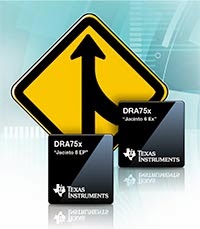
"Jacinto 6 EP" and "Jacinto 6 Ex"
infotainment processor
s
A unique approach of TI is our capability to leverage best of both worlds for non-safety critical features, and to provide a seamless integration of informational ADAS functions into existing infotainment systems so the vehicle better informs and warns the driver. We announced that capability at SAE Convergence in Detroit in October 2014 with the “Jacinto 6 Ex” processor (DRA756), which contains powerful CPU, graphics multimedia, and radio cores with differentiated vision co-processors, called embedded vision engines (EVE), and additional DSPs that perform the complex ADAS processing.

For the TI’s automotive team, the CES 2015 show is even more exciting than in previous years, as we’ve taken our concept of informational ADAS to the next step. With joint efforts and hard work from both TI and QNX teams, we’ve together implemented a real informational ADAS system running the QNX CAR™ Platform for Infotainment on a “Jacinto 6 Ex” processor.

I could try describing this system in detail, but just like the Star Wars movies, it’s best to experience our “Jacinto 6 Ex” and QNX CAR Platform-based system in person. Contact your TI or QNX representative today and schedule a meeting to visit our private suite at CES at the TI Village (N115-N119) or to immerse yourself in a combined IVI, cluster, megapixel surround view, and DLP® based HUD display with augmented reality running on a single “Jacinto 6 Ex” SoC demonstration. And don't forget to visit the QNX booth (2231), where you can see the QNX reference vehicle running a variety of ADAS and infotainment applications on “Jacinto 6” processors.

Integrated cockpit featuring DLP powered HUD and QNX CAR Platform running on a single “Jacinto 6 Ex” SoC.
One day I’ll experience Skywalker’s life as I will no doubt have the opportunity to control an intelligent and autonomous vehicle with my biometrics, voice, and gestures while riding with my family to the movie theater playing chess with my grandkids, not yet a Wookiee.

Monday, December 8, 2014

First impressions are the most lasting

Lynn Gayowski
Lynn Gayowski
Preparations for 2015 CES in January are in full swing at QNX Software Systems, both in and out of the garage. Thus, with fond memories in mind, the time has come to graduate our 2014 technology concept car, based on a Mercedes-Benz CLA45 AMG, to a CES Car of Fame. The Mercedes will always hold a special place in my heart, as it was the first technology concept car I got to experience hands-on since joining the QNX team.

If I were to describe this concept car with one word, I would choose "user-centric". (I love how hyphens can really help in these succinct situations.) We designed the infotainment system and digital instrument cluster with a vision to help drivers interact in new and seamless ways with their vehicles. This concept car is a great example of how QNX technology can enable a more natural user experience.

As we hum a few bars of Sarah McLachlan's classic I Will Remember You, let's look back at some highlights.

The first thing that catches your eye is the matte exterior and stylish lines, exuding just a soupçon of James Bond:

QNX 2014 technology concept car - exterior

But let's get to the technology. At 21" by 7" the touch screen is a showstopper. It brings a rich, graphical interface to both driver and passenger. This is where you can really see the user-centric design, with options to control the infotainment system with the touch screen, physical buttons, a jog wheel, or voice commands:

QNX 2014 technology concept car - infotainment system

We really wanted to use the car to highlight the flexibility of the QNX CAR Platform and how customers can easily modify features using the platform's pre-integrated technologies. A great example of this is the car's navigation system. The car actually has 4 different navigation solutions installed, demonstrating how automakers can choose a solution best suited for a particular geography or language. EB Street Director is featured in this photo:

QNX 2014 technology concept car - navigation

The infotainment system may wow you, but don't forget about the cluster. The Mercedes has a dynamically reconfigurable digital instrument cluster that can display turn-by-turn directions, notifications of incoming phone calls, video from the car's front and rear cameras, as well as a tachometer, speedometer, and other virtual instruments, at a full 60 frames per second. The cluster can even notify you of incoming text messages on your phone. Simply push a steering-wheel button, and the system will read the message aloud, so you can keep your eyes on the road.

QNX 2014 technology concept car - cluster

Another cool feature is the cluster's "virtual mechanic" which lets you access vehicle info like tire pressure, brake wear, and fuel, oil, and windshield fluid levels:

QNX 2014 technology concept car - virtual mechanic

What car of the future would be complete without connectivity? A custom "key fob" app allows you to remotely access system maintenance information, control the media player, locate the car on a map, and perform a number of actions like starting the car and opening window. This cross-platform HTML5 app can run on any smartphone or tablet:

QNX 2014 technology concept car - key fob

As an overall view of the Mercedes, one of my favourite pieces is this video by Sami Haj-Assaad of AutoGuide, where he takes a look at the design and features of the car. His closing quote really sums up the innovation showcased: "The infotainment industry is going through a huge upgrade, with QNX leading the charge."


I hope you enjoyed the 2014 QNX technology concept car. Watch for the reveal of our 2015 technology concept car January 6 at CES in Las Vegas!

Wednesday, November 5, 2014

Japan update: ADAS, wearables, integrated cockpits, and autonomous cars

Yoshiki Chubachi
Yoshiki Chubachi
Will the joy of driving be a design criterion for tomorrow’s vehicles? It had better be.

A couple of weeks ago, QNX Software Systems sponsored Telematics Japan in Tokyo. This event offers a great opportunity to catch up with colleagues from automotive companies, discuss technology and business trends, and showcase the latest technology demos. Speaking of which, here’s a photo of me with a Japan-localized demo of the QNX CAR Platform. You can also see a QNX-based digital instrument cluster in the lower-left corner — this was developed by Three D, one of our local technology partners:


While at the event, I spoke on the panel, “Evolving ecosystems for future HMI, OS, and telematics platform development.” During the discussion, we conducted a real-time poll and asked the audience three questions:

1) Do you think having Apple CarPlay and Android Auto will augment a vehicle brand?
2) Do you expect wearable technologies to be integrated into cars?
3) If your rental car were hacked, who would you complain to?

For question 1, 32% of the audience said CarPlay and Android Auto will improve a brand; 68% didn't think so. In my opinion, this result indicates that smartphone connectivity in cars is now an expected feature. For question 2, 76% answered that they expect to see wearables integrated into cars. This response gives us a new perspective — people are looking at wearables as a possible addition to go with ADAS systems. For example, a wearable device could help prevent accidents by monitoring the driver for drowsiness and other dangerous signs. For question 3, 68% said they would complain to the rental company. Mind you, this raises the question: if your own car were hacked, who would you complain to?

Integrated cockpits
There is growing concern around safety and security as companies attempt to grow more business by leveraging connectivity in cars. The trend is apparent if you look at the number of safety- and security-related demos at various automotive shows.

Case in point: I recently attended a private automotive event hosted by Renesas, where many ADAS and integrated cockpit demos were on display. And last month, CEATEC Japan (aka the CES of Japan) featured integrated cockpit demos from companies like Fujitsu, Pioneer, Mitsubishi, Kyocera, and NTT Docomo.

For the joy of it
Things are so different from when I first started developing in-car navigation systems 20 years ago. Infotainment systems are now turning into integrated cockpits. In Japan, the automotive industry is looking at early 2020s as the time when commercially available autonomous cars will be on the road. In the coming years, the in-car environment, including infotainment, cameras and other systems, will change immensely — I’m not exactly sure what cars in the year 2020 will look like, but I know it will be something I could never have imagined 20 years ago.

A panel participant at Telematics Japan said to me, “If autonomous cars become reality and my car is not going to let me drive anymore, I am not sure what the point of having a car is.” This is true. As we continue to develop for future cars, we may want to remind ourselves of the “joy of driving” factor.

Wednesday, October 22, 2014

A question of architecture

The second of a series on the QNX CAR Platform. In this installment, we start at the beginning — the platform’s underlying architecture.

In my previous post, I discussed how infotainment systems must perform multiple complex tasks, often all at once. At any time, a system may need to manage audio, show backup video, run 3D navigation, synch with Bluetooth devices, display smartphone content, run apps, present vehicle data, process voice signals, perform active noise control… the list goes on.

The job of integrating all these functions is no trivial task — an understatement if ever there was one. But as with any large project, starting with the right architecture, the right tools, and the right building blocks can make all the difference. With that in mind, let’s start at the beginning: the underlying architecture of the QNX CAR Platform for Infotainment.

The architecture consists of three layers: human machine interface (HMI), middleware, and platform.


The HMI layer
The HMI layer is like a bonus pack: it supports two reference HMIs out of the box, both of which have the same appearance and functionality. So what’s the difference? One is based on HTML5, the other on Qt 5. This choice demonstrates the underlying flexibility of the platform, which allows developers to create an HMI with any of several technologies, including HTML5, Qt, or a third-party toolkit such as Elektrobit GUIDE or Crank Storyboard.

A choice of HMIs
Mind you, the choice goes further than that. When you build a sophisticated infotainment system, it soon becomes obvious that no single tool or technology can do the job. The home screen, which may contain controls for Internet radio, hands-free calls, HVAC, and other functions, might need an environment like Qt. The navigation app, for its part, will probably use OpenGL ES. Meanwhile, some applications might be based on Android or HTML5. Together, all these heterogeneous components make up the HMI.

The QNX CAR Platform embraces this heterogeneity, allowing developers to use the best tools and application environments for the job at hand. More to the point, it allows developers to blend multiple app technologies into a single, unified user interface, where they can all share the same display, at the same time.

To perform this blending, the platform employs several mechanisms, including a component called the graphical composition manager . This manager acts as a kind of universal framework, providing all applications, regardless of how they’re built, with a highly optimized path to the display.

For example, look at the following HMI:


Now look at the HMI from another angle to see how it comprises several components blended together by the composition manger:


To the left, you see video input from a connected media player or smartphone. To the right, you see a navigation application based on OpenGL ES map-rendering software, with an overlay of route metadata implemented in Qt. And below, you see an HTML page that provides the underlying wallpaper; this page could also display a system status bar and UI menu bar across all screens.

For each component rendered to the display, the graphical composition manager allocates a separate window and frame buffer. It also allows the developer to control the properties of each individual window, including location, transparency, rotation, alpha, brightness, and z-order. As a result, it becomes relatively straightforward to tile, overlap, or blend a variety of applications on the same screen, in whichever way creates the best user experience.

The middleware layer
The middleware layer provides applications with a rich assortment of services, including Bluetooth, multimedia discovery and playback, navigation, radio, and automatic speech recognition (ASR). The ASR component, for example, can be used to turn on the radio, initiate a Bluetooth phone call from a connected smartphone, or select a song by artist or song title.

I’ll drill down into several of these services in upcoming posts. For now, I’d like to focus on a fundamental service that greatly simplifies how all other services and applications in the system interact with one another. It’s called persistent/publish subscribe messaging, or PPS, and it provides the abstraction needed to cleanly separate high-level applications from low-level business logic and services.

PPS messaging provides an abstraction layer between system services and high-level applications

Let’s rewind a minute. To implement communications between software components, C/C++ developers must typically define direct, point-to-point connections that tend to “break” when new features or requirements are introduced. For instance, an application communicates with a navigation engine, but all connections enabling that communication must be redefined when the system is updated with a different engine.

This fragility might be acceptable in a relatively simple system, but it creates a real bottleneck when you are developing something as complex, dynamic, and quickly evolving as the design for a modern infotainment system. PPS addresses the problem by allowing developers to create loose, flexible connections between components. As a result, it becomes much easier to add, remove, or replace components without having to modify other components.

So what, exactly, is PPS? Here’s a textbook answer: an asynchronous object-based system that consists of publishers and subscribers, where publishers modify the properties of data objects and the subscribers to those objects receive updates when the objects have been modified.

So what does that mean? Well, in a car, PPS data objects allow applications to access services such as the multimedia engine, voice recognition engine, vehicle buses, connected smartphones, hands-free calling, and contact databases. These data objects can each contain multiple attributes, each attribute providing access to a specific feature — such as the RPM of the engine, the level of brake fluid, or the frequency of the current radio station. System services publish these objects and modify their attributes; other programs can then subscribe to the objects and receive updates whenever the attributes change.

The PPS service is programming-language independent, allowing programs written in a variety of programming languages (C, C++, HTML5, Java, JavaScript, etc.) to intercommunicate, without any special knowledge of one another. Thus, an app in a high-level environment like HTML5 can easily access services provided by a device driver or other low-level service written in C or C++.

I’m only touching on the capabilities of PPS. To learn more, check out the QNX documentation on this service.

The platform layer
The platform layer includes the QNX OS and the board support packages, or BSPs, that allow the OS to run on various hardware platforms.

An inherently modular and extensible architecture
A BSP may not sound like the sexiest thing in the world — it is, admittedly, a deeply technical piece of software — but without it, nothing else works. And, in fact, one reason QNX Software Systems has such a strong presence in automotive is that it provides BSPs for all the popular infotainment platforms from companies like Freescale, NVIDIA, Qualcomm, and Texas Instruments.

As for the QNX Neutrino OS, you could write a book about it — which is another way of saying it’s far beyond the scope of this post. Suffice it to say that its modularity, extensibility, reliability, and performance set the tone for the entire QNX CAR Platform. To get a feel for what the QNX OS brings to the platform (and by extension, to the automotive industry), I invite you to visit the QNX Neutrino OS page on the QNX website.

Tuesday, October 21, 2014

A sweet ride? You’d better 'beleave' it

Is Autumn the best season for a long, leisurely Sunday drive? Well, I don’t know about your neck of the woods, but in my neck, the trees blaze like crimson, orange, and yellow candles, transfiguring back roads into cathedrals of pure color. When I see every leaf on every tree glow like a piece of sunlight-infused stained glass, I make a religious effort to jump behind the wheel and get out there!

Now, of course, you can enjoy your Autumn drive in any car worth its keep. But some cars make the ride sweeter than others — and the Mercedes S Class Coupe, with its QNX-powered infotainment system and instrument cluster, is deliciously caloric.

This isn’t a car for the prim, the proper, the austere. It’s for pure pleasure – whether you take pleasure in performance, luxury, or beauty of design. Or all three. The perfect car, in other words, for an Autumn drive. Which is exactly what the folks at Mercedes thought. In fact, they made a photo essay about — check it out on their Facebook page.


Source: Mercedes

Thursday, October 16, 2014

Attending SAE Convergence? Here’s why you should visit booth 513

Cars and beer don’t mix. But discussing cars while having a beer? Now you’re talking. If you’re attending SAE Convergence next week, you owe it to yourself to register for our “Spirits And Eats” event at 7:00 pm Tuesday. It’s the perfect occasion to kick back and enjoy the company of people who, like yourself, are passionate about cars and car electronics. And it isn’t a bad networking opportunity either — you’ll meet folks from a variety of automakers, Tier 1s, and technology suppliers in a relaxed, convivial atmosphere.

But you know what? It isn’t just about the beer. Or the company. It’s also about the Benz. Our digitally modded Mercedes-Benz CLA45 AMG, to be exact. It’s the latest QNX technology concept car, and it’s the perfect vehicle (pun fully intended) for demonstrating how QNX technology can enable next-generation infotainment systems. Highlights include:

  • A multi-modal user experience that blends touch, voice, and physical controls
  • A secure application environment for Android, HTML5, and OpenGL ES
  • Smartphone connectivity options for projecting smartphone apps onto the head unit
  • A dynamically reconfigurable digital instrument cluster that displays turn-by-turn directions, notifications of incoming phone calls, and video from front and rear cameras
  • Multimedia framework for playback of content from USB sticks, DLNA devices, etc.
  • Full-band stereo calling — think phone calls with CD quality audio
  • Engine sound enhancement that synchronizes synthesized engine sounds with engine RPM

Here, for example, is the digital cluster:


And here is a closeup of the head unit:


And here’s a shot of the cluster and head unit together:


As for the engine sound enhancement and high-quality hands-free audio, I can’t reproduce these here — you’ll have come see the car and experience them first hand. (Yup, that's an invite.)

If you like what you see, and are interested in what you can hear, visit us at booth #513. And if you'd like to schedule a demo or reserve some time with a QNX representative in advance, we can accommodate that, too. Just send us an email.